PRESS RELEASE
3.9.2026
Pharmacies' medicine compounding capability is part of security of supply — in Finland, it is thinning out
The end of contract compounding at the Töysä Pharmacy in Alavus has brought into public discussion the availability of medicines for patients who need customized doses. Ex tempore compounding is not banned and is not disappearing. What does deserve discussion, however, is a broader question: will Finland retain the ability to compound medicines when the industrial supply chain fails to deliver them? At EU level, distributed pharmacy compounding has been recognized as a preparedness issue and is being funded; in Finland, only two contract compounders remain. Pharmacist-owner Samuli Ojala and Niklas Sandler Topelius, founder of CurifyLabs, which develops medicine-compounding technology, propose building a geographically distributed network of capable pharmacies in Finland, with authorities and industry operators preparing the rules of the game jointly.
What is actually at stake
A public impression has formed that the availability of all ex tempore medicines is now under threat. This is not the case, and a clarification is warranted: patients have no reason to be concerned about this.
The underlying restrictions concern large-scale compounding for stock. By definition, an ex tempore medicine is only compounded after a doctor has prescribed it for an individual patient, and this will continue to be possible without a separate authorization. In contract compounding, the ordering pharmacy places an order with another, compounding pharmacy on the basis of that prescription; the basis for compounding is therefore the prescription, not the order itself.
What is under threat is not ex tempore compounding as an operating model. What is under threat is the ability to keep the most common customized preparations actually available. Many of the high-volume products compounded in Töysä are now found in the stockroom of nearly every pharmacy, and a patient can get one off the shelf the same day. If the same product had to be compounded separately for each patient after a prescription, a preparation available instantly from the shelf could easily turn into a wait of several weeks.
Compounding capability is built before a disruption occurs
Elina Järvenpää, pharmacist-owner in Töysä, described the situation to Yle on 31 August: "You can't set up this kind of production quickly. The capacity to act, skilled staff, premises, equipment and methods count for a great deal." According to Järvenpää, despite its small size the pharmacy has been able to respond to sudden needs, such as medicine availability problems during the pandemic.
This observation is essential from a preparedness standpoint. Compounding capability is not a product that can be ordered once a disruption has begun. It consists of personnel, premises, equipment, raw materials, validated methods, a quality system and documentation, and these would need to be in place before a disruption occurs.
Finland's medicine supply preparedness is currently based mainly on stockpiles. The Act on Mandatory Stockpiling of Medicines obliges pharmaceutical companies, importers, healthcare units and the Finnish Institute for Health and Welfare to hold stocks of key medicines, for the most important preparations equivalent to as much as ten months' consumption. The system covers marketing-authorized preparations as well as the active substances, excipients and packaging materials used in compounding, for the obligated operators. Pharmacies' medicine compounding is not included in the mandatory stockpiling scheme: there is no stockpiling obligation for the raw materials used in pharmacy compounding, and the system does not recognize pharmacies' compounding capability. This would be worth assessing as part of overall preparedness.
The importance of compounding capability has been recognized elsewhere in Finland's medicine supply system. The Military Pharmacy maintains reserve production readiness for medicines, especially infusion solutions, in cooperation with the National Emergency Supply Agency and universities. In the draft amendment to the Medicines Act circulated for comment in June 2026, it is proposed that the Military Pharmacy's right to compound medicines be enshrined in law more clearly than at present, with security of supply cited as the justification.
Reserve production readiness is thus an established concept in Finland. For community pharmacies, this possibility has not so far been recognized.
Distributed compounding has been identified as a preparedness issue at EU level
Within the European Union, the role of pharmacy compounding and distributed compounding in preparedness has been recognized, and funding is being directed toward it.
The EU4Health programme funds, for example, the RoboPharma project, which the Commission describes on its own website as a distributed medicine manufacturing platform intended to improve crisis preparedness. It involves pharmacies and university hospitals from five countries, including Hietalahti Pharmacy in Vaasa and the Paris-based Pharmacie Delpech. The project has a total budget of €5.6 million and runs until 2028. The project is coordinated by CurifyLabs, because we consider preparedness and the possibilities of distributed manufacturing important.
The same thinking is reflected in legislation currently being prepared. The Commission's proposal for a Critical Medicines Act, put forward in March 2025, defines an "innovative manufacturing process," and the definition explicitly mentions distributed manufacturing and 3D manufacturing. The purpose of the regulation is to secure the availability and manufacturing capacity of critical medicines within the Union; the Council and Parliament reached a provisional agreement on it in May 2026. The proposal does not regulate pharmacy compounding and does not mention it, but distributed manufacturing is named in it as a manufacturing method.
Distribution is not always the cheapest option in terms of unit costs, but in a sparsely populated country of long distances such as Finland, it is a key part of managing logistics-related risks. The same would apply to distributed medicine compounding.
More broadly, the EU's preparedness approach has shifted toward reserving manufacturing capacity in advance: the Health Emergency Preparedness and Response Authority (HERA) maintains reserved vaccine production capacity and, in summer 2026, launched a network for rapid scale-up of production. The underlying logic is the same as in pharmacy compounding: capacity incurs costs even when it is not being used, and that is precisely the nature of preparedness.
Juha Sinnemäki, Head of the Licensing and Inspection Unit at Fimea, the Finnish Medicines Agency, told Yle on 31 August: "If we were to face a genuine crisis in which we could not obtain high-volume products in Finland..." This assessment is justified as far as it concerns the current situation: the remaining capacity does not replace industrial production, and in the largest therapeutic areas there are, given the market's attractiveness, plenty of alternatives.
From a preparedness perspective, however, the conclusion would be different. The capacity of distributed compounding is determined not by the method of manufacture but by how many units have been equipped, trained and kept operationally ready in advance. The capacity of a network of a hundred pharmacies is an entirely different order of magnitude from that of a single one, and the scale can be decided in advance — which is precisely why this is a matter of preparedness rather than improvisation. In France, 47 pharmacies covered a few percent of pediatric amoxicillin consumption in a situation where capacity had not been built up in advance specifically for that purpose; with a pre-equipped network, the ceiling would be different.
This is thus a matter both of individual, low-volume but essential preparations for patients, and of how large a need the country could meet if required. There is also the further question of when a pharmacy has the authorization and the capability to compound a preparation while it is in shortage and unavailable on the market — and while the active substance is available or in stock. Obtaining a special-authorization product imported from abroad takes a long time, and its availability varies. Often this also concerns a product that is missing from the market altogether or being withdrawn from it: for example, an older molecule in which industrial manufacturers no longer have any commercial interest, but which has found a new indication for use. In Finland, there is so far no established procedure for this.
What capability remains, and who needs it
As a result of a long-running trend, only just over a hundred pharmacies remain in Finland capable of compounding even an ointment or a suspension, and only a handful of operators capable of a broader range or continuous, daily compounding. The number of contract manufacturers has fallen from three to two.
There are many who need this: mostly children, the chronically ill, cancer patients and pets. They are present in every region.
Elsewhere, authorization is linked to the availability situation
In the Netherlands, supply between pharmacies has been possible since February 2025 by ministerial decision. The supervisory authority issues a separate authorization decision when no suitable, marketing-authorized alternative is available in the country, the compounding pharmacy complies with GMP, and it has a functioning pharmacovigilance system in place. The conditions are strict, and they are set out explicitly.
In France, a pharmacy may delegate compounding, under a written agreement, to another pharmacy that holds prior authorization from the regional health authority to act as a subcontractor. When there was a shortage of amoxicillin for young children over the turn of the year 2022–2023, the medicines agency allowed pharmacies to compound the missing preparation themselves, and 47 pharmacies with subcontracting authorization were permitted to supply it to other pharmacies. The arrangement was wound down in an orderly manner in spring 2025, once availability had stabilized. Pharmacy compounding is estimated to have covered a few percent of pediatric amoxicillin consumption; it did not replace industrial production, but it kept treatment available. The structure and the trigger mechanism were in place before the disruption occurred.
In the United States, an equivalent link is written into law. For facility-based pharmacy compounding, the prohibition on compounding a preparation essentially similar to an approved medicine does not apply if the preparation is on the medicines agency's shortage list, in which case use of the active substance is explicitly permitted. Authorization is thus linked to the specific situation in which the preparation is unavailable on the market but the active substance is available, and it lapses, after a transition period, once the shortage is resolved. What is of interest is not this model as such but its structure: authorization is tied to the availability situation, quality requirements are codified, and the arrangement ends on its own.
The compromise text of the EU's new pharmaceutical directive, published in March 2026, points in the same direction: member states could allow compounding at population level when the purpose is to alleviate or resolve an availability shortage, or when no suitable marketing-authorized preparation is available on the market. This regulation will apply from 2028.
National discretion is being used right now
The draft amendment to the Medicines Act circulated for comment in June 2026 updates hospital pharmacies' medicine compounding rights, provides for the Military Pharmacy's compounding rights, and would open the possibility for pharmacy operators to compound medicinal gases with Fimea's authorization. The justification given is security of supply.
The draft does not touch community pharmacies' compounding. In its own statement, the Finnish Pharmacists' Association (Apteekkariliitto) noted that the effects of the changes on community pharmacies have not been assessed with sufficient rigor. The Finnish Pharmacists' Association [Farmasialiitto], for its part, stated that medicine compounding is a significant part of security of supply in the medicine supply chain, and that enabling legislation supports Finland's preparedness for emergency conditions.
The Court of Justice of the European Union confirmed in spring 2026 that the regulation of pharmacy preparations falling outside the scope of the directive is a matter for member states' competence. National discretion is thus available, and it is being used right now, justified by security of supply. This, however, does not cover community pharmacy care — the channel through which the majority of the population obtains its medicines. It could be worth extending the same consideration there as well.
Proposal: a distributed network of capable pharmacies
The authors' proposal is that, alongside and in place of centralized contract compounding, a suitably geographically distributed network of capable pharmacies be built.
Ex tempore compounding is, as a method, slow and prone to backlogs, and the need is often acute. When capability is concentrated in one or two units, a single retirement or production stoppage affects availability across the whole country. In a distributed network, the impact would remain local. This is the same logic by which the EU reserves manufacturing capacity in advance and by which the Military Pharmacy maintains reserve production readiness.
Such a network would not require new technology. In many European countries, the culture of ex tempore compounding has remained more firmly established than in Finland, and distributed capability has persisted there because it was never phased out. Finland's situation here is a European exception, not the norm.
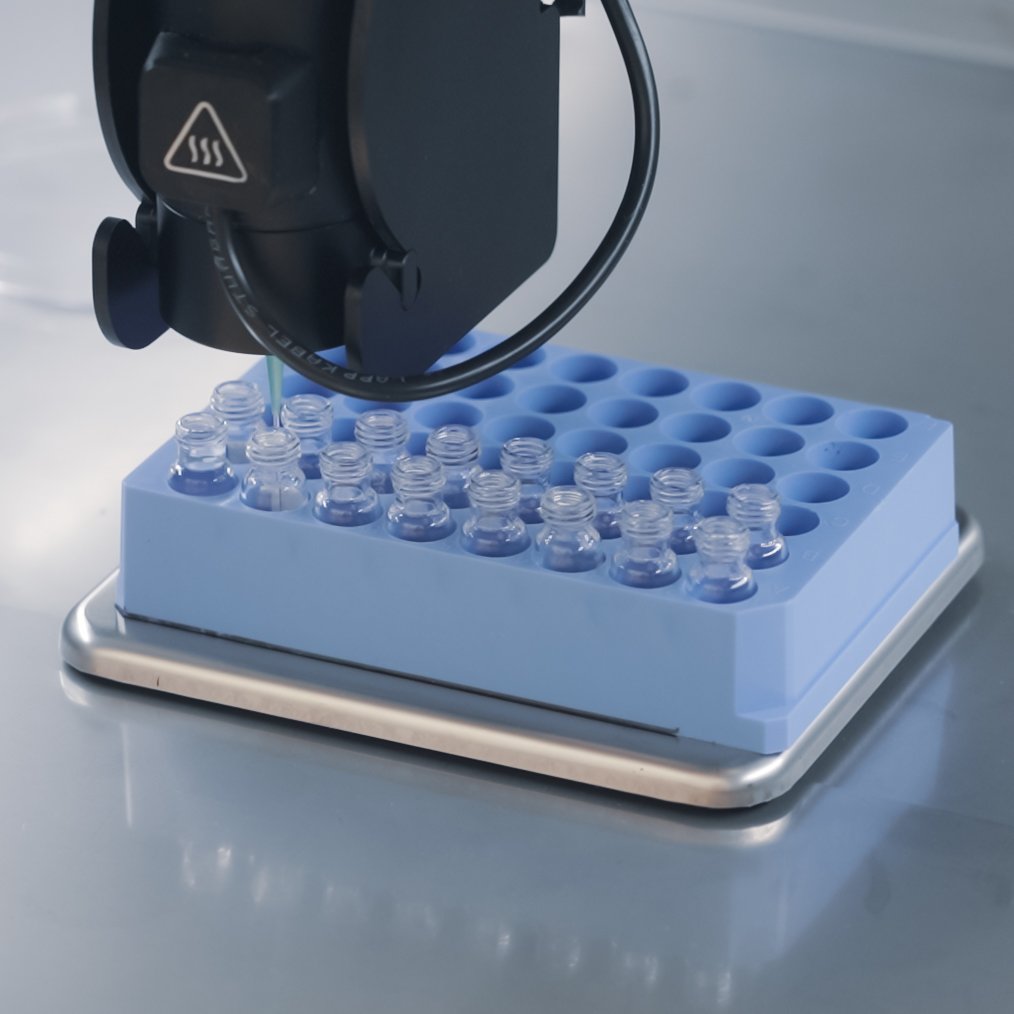
Finland's situation is thus different: the capability has already been partly lost, and rebuilding it using traditional methods alone would be slow and expensive. Automation could therefore be the fastest way forward for Finland — not because it is the only way to compound medicines. Automated compounding based on 3D printing of medicines is already in patient use in 14 European countries and 24 U.S. states. The equipment is enclosed, fits in a pharmacy's back room, and measures each dose during preparation. Premises must still be suitable for medicine compounding — the Medicines Act requires appropriate production premises and equipment, and automation does not remove this requirement — but the space required is a fraction of what a traditional compounding laboratory needs, which is essential for distribution. This method could cover a large share of the need for orally administered ex tempore medicines; ointments and other external preparations are a separate question.
Implementation would also require revisiting pricing
The proposal could only be implemented if the economic basis for pharmacy compounding were sound. This is the only section of this release concerning economics.
The price of a medicine compounded in a pharmacy is set by a government decree on the medicine tariff. Under the decree, a fee of €6.73 may be charged for compounding a non-sterile medicine, €13.46 for compounding a sterile medicine, and €1.68 for weighing a substance. These euro amounts are currency conversions of the 1998 Finnish markka amounts of 40, 80 and 10 markkaa: the compounding fees were set at their current level on 1 April 1998, converted to euros at the start of 2002, and carried over unchanged into the present decree. They have not been revised since.
Nor is there any route to cost-covering pricing, since Kela (the Social Insurance Institution of Finland) reimburses the customer for an ex tempore preparation only at the price set by the medicine tariff.
The medicine tariff does not recognize the full costs of compliant medicine compounding. Since the tariff came into force, quality requirements have tightened considerably and technology has advanced to a level that was at the time considered utopian. The regulations governing pharmacies' medicine compounding require that the principles of the Commission's GMP guide be followed as applicable — in more detail the broader and more demanding the activity is — that quality-control testing be carried out in accordance with the European Pharmacopoeia, that equipment and measuring instruments be serviced and calibrated at regular intervals, that the shelf life be known at least for preparations compounded for stock, and that documentation be retained for at least five years. The Medicines Act further requires appropriate production premises. These are justified patient-safety requirements, and precisely for that reason the costs they entail — the quality system, analytics, premises, qualification, single-use materials, software and cleaning — would be worth recognizing in pricing as well. Nor does the tariff recognize automated compounding as a manufacturing method in its own right; it is written for manual work in a traditional pharmacy laboratory.
Under current conditions, expanding compounding capacity is not economically feasible for a pharmacy, and the capability that remains rests largely on the interest and sense of duty of individual pharmacy owners. Technology alone will not resolve the pricing issue, and revising pricing alone will not restore the capability. Both would be needed.
The authors propose
- Pharmacies' compounding capability should be assessed as part of medicine supply preparedness. Mandatory stockpiling secures stocks, and the Military Pharmacy maintains reserve production readiness; community pharmacies' compounding capability falls outside both. The assessment should also cover how the availability of raw materials for pharmacy compounding is secured within the country, and it would be useful to name a responsible party for this.
- A procedure should be created whereby a shortage would enable compounding for a defined period. When a preparation is in shortage and no alternative is available on the market, a pharmacy could compound it from the active substance under clear conditions, with the arrangement lapsing once availability is restored. An equivalent structure is in place in the United States, codified in law, and in France, through decisions of the medicines agency, and the EU's new pharmaceutical directive will enable this from 2028.
- The Medicines Act update currently being prepared should be extended to cover community pharmacy compounding as well. The same security-of-supply justification used to clarify the compounding rights of hospital pharmacies and the Military Pharmacy would be applicable to community pharmacy care.
- The government decree on the medicine tariff should be updated with respect to compounding pricing, and pricing should be linked to cost trends. The decree should also take into account the costs entailed by quality requirements. From the patient's perspective, it would be desirable for Kela's reimbursement practice to remain unchanged — a pricing correction should not be passed on in full to the patient.
- The rules of the game should be prepared jointly. A shared understanding is needed of pharmacies' ex tempore compounding and distributed compounding as a solution to availability problems of varying severity — preferably proactively, rather than one crisis at a time.
Quotes
Samuli Ojala, pharmacist-owner:
"At my own pharmacy, the queue for capsule compounding currently runs two to three weeks, so there is no shortage of need. The problem is that every batch we compound is a loss for us, and the more we produce, the greater the loss becomes. Under current conditions, we cannot increase capacity any further."
"I would welcome cooperation in which industry operators and regulators worked together to get the pieces in place, so that those who need help would continue to receive it, and so that the operating environment would be clear and predictable for everyone."
Niklas Sandler Topelius, Founder and Chief Technology Officer, CurifyLabs:
"Distributed pharmacy compounding is seen in Europe as one answer to medicine manufacturing disruptions and to security of supply, which is why it is being funded. We ourselves coordinate one such project, because we consider the subject important. The technology was developed in Finland, based on Finnish university research, and it is already in patient use in several European countries and in the United States."
"We are not presenting equipment as the solution to a structural question. Our proposal is that once pricing and the rules of the game are put in order, the capability could be rebuilt quickly, to a high standard, and in a distributed way. Premises suitable for medicine compounding would still be needed going forward, but they would not need to be a full compounding laboratory."
Facts
|
Contract-compounding pharmacies in Finland |
3 (2017) → 2 (2026) |
|
Pharmacies capable of compounding at least an ointment or a suspension |
just over 100 |
|
Pharmacies capable of a broad range or daily compounding |
a handful |
|
Mandatory stockpiling covers pharmacies' compounding capability or its raw materials |
no |
|
Established procedure enabling pharmacy compounding during a shortage |
none exists |
|
RoboPharma project total budget |
5,6 M€, running until 2028 |
|
Maximum fee chargeable for non-sterile compounding |
6,73 € (= 40 mk, 1998) |
|
For sterile compounding |
13,46 € (= 80 mk, 1998) |
|
Weighing / preparing a substance for use |
1,68 € (= 10 mk, 1998) |
|
Compounding fees set at current level |
1 April 1998 |
|
Medicine-tariff line items for quality control, GMP, pharmacopoeia testing, single-use materials, software, cleaning, or premises |
none |
Further information
Samuli Ojala, pharmacist-owner, Hietalahti Pharmacy, Vaasa — +358 40 5278875
Niklas Sandler Topelius, Founder and Chief Technology Officer, CurifyLabs — +358 50 3633123
Interview requests, filming of compounding work at the pharmacy, and equipment demonstrations can be arranged. A source list for the claims made in this release will be provided on request.
CurifyLabs is a Finnish company developing automated medicine compounding for pharmacies and hospital pharmacies, and coordinates the EU4Health-funded RoboPharma project. Sandler Topelius is the company's founder, Chief Technology Officer and a shareholder. Hietalahti Pharmacy in Vaasa is a participant in the RoboPharma project and uses CurifyLabs' technology.
Sources
- Euroopan komissio: RoboPharma – Agile Pharmaceutical Manufacturing, EU4Health-ohjelma
- Komission ehdotus asetukseksi kriittisistä lääkkeistä, COM(2025) 102 final, 11.3.2025, 3 ja 5 artikla; neuvoston ja parlamentin alustava sopimus 12.5.2026
- HERA: valmistuskapasiteetin varaukset ja kesällä 2026 käynnistetty tuotantoverkosto
- Laki lääkkeiden velvoitevarastoinnista 979/2008 ja valtioneuvoston asetus 1114/2008; STM:n lausuntokierros 1.6.–20.7.2026
- Puolustusvoimien logistiikkalaitos: Sotilasapteekin tehtävät, ml. lääkkeiden varatuotantovalmius
- Luonnos hallituksen esitykseksi laiksi lääkelain muuttamisesta, VN/34687/2025 (lausunnolla 18.6.–13.8.2026); Apteekkariliiton lausunto 18.8.2026; Farmasialiiton lausunto 31.7.2026
- Valtioneuvoston asetus lääketaksasta 713/2013, liite; asetukset 1087/2002 ja 844/2001; valtioneuvoston päätökset 24/1998 ja 220/1998
- Lääkelaki 395/1987, 15 §; Fimean määräys 6/2011 "Apteekkien lääkevalmistus"
- Kela: apteekkien sairausvakuutusohje ja ohje ex tempore -lääkevalmisteiden korvattavuudesta
- Direktiivi 2001/83/EY, 3 artikla; unionin tuomioistuin, asia C-589/24 (19.3.2026); uuden lääkedirektiivin kompromissiteksti 6.3.2026
- Alankomaat: Beleidsregel collegiaal doorleveren en ter hand stellen van apotheekbereidingen (Staatscourant 2024 nr. 39917, voimaan 1.2.2025)
- Ranska: Code de la santé publique L.5125-1 ja L.5125-23; décret n° 2014-1367; ANSM:n päätökset 2022–2025
- Yhdysvallat: Federal Food, Drug, and Cosmetic Act § 503B (21 U.S.C. § 353b), erityisesti 503B(a)(2) ja 503B(d)(2)(A)(i); § 506E (21 U.S.C. § 356e)
- Yle 31.8.2026: Töysän apteekin omistajavaihdos uhkaa lääkkeiden saatavuutta yli 700 apteekissa
- Sandler Topelius ym., Pharmaceutics 2024;16(5):678